11.10.2007

Iron Road: A Raymond Chandler Moment.

"Mrs. Keunecke," Nancy said. She wasn't shouting. Anybody walking on the sidewalk might have overheard her, but there wasn't anybody on the sidewalk, not in February before school let out. "Surely you've heard about me. I've lived in this town most of my life. People know me. I'm no lady, Mrs. Keunecke. I'm rough and rowdy and I like boys too much. I've busted more windows, on purpose, than you have fingers. I've been sneaking cigarettes since I was thirteen. I broke a boy's arm when I was fifteen. I'm nosy, and I'm stubborn, and I'm mean. I don't care what happens to you, and I will make sure you lose your job if you don't open this door."

"Are you threatening me?"

Some people are just slower than others, Nancy thought. "Yes, m'am."

11.08.2007

West Branch Art

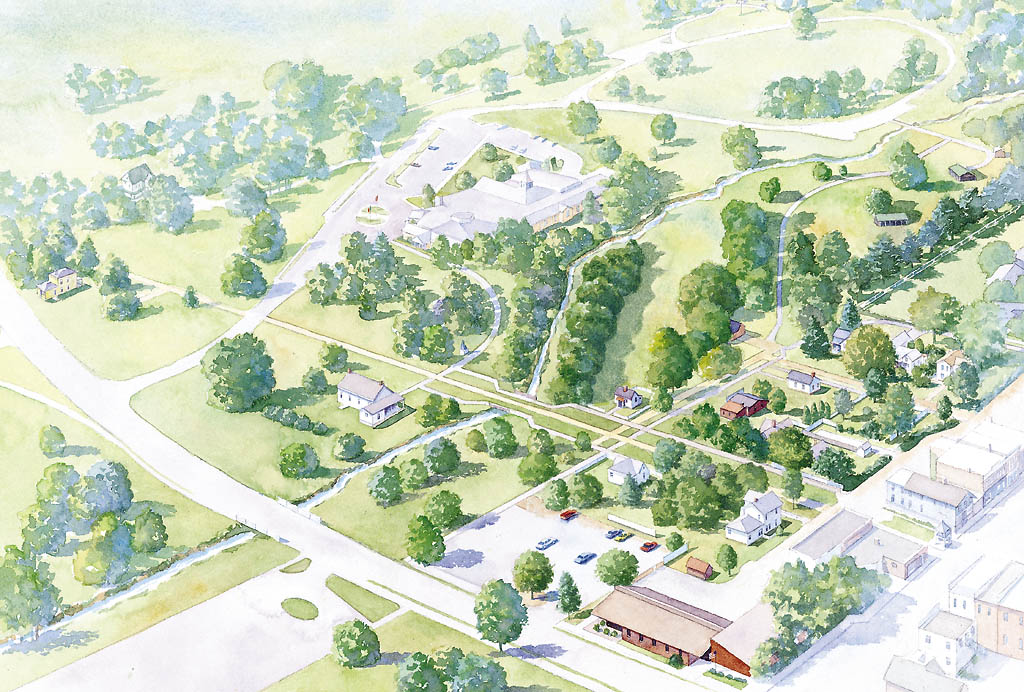
Grant Wood, of "American Gothic" fame, painted a picture of the Hoover cottage being shown off by a tour guide: The Brithplace of Herbert Hoover. It wouldn't have been accurate, but I wish he'd painted Isis in the shadow of the trees off to the right.

Rob Wood (no relation?) painted a bird's-eye view of West Branch. The big building toward the top is the library/museum; there's a curving walkway to a smaller white building (I forget what that was). On the curved walkway is a black lump on top of a white lump: that's the statue. Hoover's house is small and white with a reddish roof. It has a white fence and is across the bridge with grass on it from the library. I think the Opera Block (home of the former West Branch Opera House) is in the lower right corner, from the backside. There was a truly excellent steakhouse right around there, but I forget what it was called. The pizza place is still there--Herb 'n' Lou's.

Iron Road: Gypsies

Another Iron Road bit:

Another fantasy. Whatever had taken out the rails had been quick, rough, and almost certainly loud. The railroad ties, which were old but good enough to reuse (there were fewer of them lying around, from what she could tell), had shattered and splintered, in some places even turning to sawdust. The amount of dirt that had been pulled out of the ground and the distance it appeared to have scattered also pointed toward the rails having been jerked out of the ground. It would have taken a tractor or a tank to do the work. Gypsies. Gypsies are well-known for their tanks.

11.07.2007

More Iowa History.

After WWI, President Hoover received a bronze statue of the Egyptian Goddess Isis from a group of Belgian schoolchildren, soldiers, and refugees. Whatever possessed them to pick Isis, I'm not sure.

At the time, Isis was considered the Goddess of Life. The inscription at the base of the statue (not at the base of the pedestal), if I remember right, reads: "I am all that has been, that is, that shall be, and none among mortals has yet dared to raise my veil."

It's surrounded by old pine trees and was usually fairly shaded. On one side is the Hoover Presidential Library and Museum and on the other a recreation of Hoover's birthplace (including a blacksmith shop full of inveresting tools and scraps). And then this occult statue (it isn't Egyptian in style at all) jumps out at you and claims to be the source of all mysteries. I would have thought someone would have lodged a protest by now...

The Little Old Lady Rules.

Bunch of e-mails circulating at work about "The Woman's Rules" "The Man's Rules"--even "The Chocolate Rules," so I came up with my own version:

The Little Old Lady Rules

(The logic here is that I have a little box in my brain marked "inappropriate." There's a little old lady in that box. She says things like this...and I think she'll get a little louder, the older I get.)

  1. All the chocolate is mine.
  2. All the good chocolate is really mine. I will share the rest, because I am the soul of magnaniminimininty.
  3. People are dumb, which is good, because otherwise I would run out of things to laugh at.
  4. I am always beautiful, witty, kind, and wonderful. I don't need you to tell me whether the dress looks good, I look fat, etc. I look good inthis dress, and I'm not fat.
  5. Any joke that shocks someone half my age is a good joke.
  6. Some babies are ugly. But you have to love them anyway.
  7. Some kids are brats. Smack 'em when their parents aren't looking.
  8. Never answer the phone. Or the door. If you do, anything you say to a telemarketer, politician, salesbobo, or religious zealot doesn'tcount in the afterlife.*
  9. It's time for your children to grow up.
  10. I don't care what you think. Unless you think you want to give me chocolate.

  11. *Don't mess with the Girl Scouts.

11.06.2007

Iowa History.

Lee and I used to live in West Branch, Iowa, birthplace of President Herbert Hoover. The town is also the home of Scattergood Friends School, a college-prep school run by the Iowa Yearly Meeting of Friends (Conservative) (that is, by Quakers).

From 1938-1943 it was also run as a hostel for Jewish people and political refugees from Europe:
By July of 1939 Scattergood Hostel seemed settled enough for the first family to arrive. By August the targeted population of 30 "guest" (the term used in preference to the more loaded "refugees") and 10 or so staff was mostly in place. At that point, daily life at Scattergood Hostel began to reflect more closely the AFSC's goal of providing a place where refugees "could go for a few weeks or months to recover from their effects of their recent experiences, regain their confidence , improve their English, learn to drive a car, and, if needed be, start retaining themselves for some new line of work before seeking a permanent place in American society." True to Quaker aversion to organized hierarchies, from the beginning attempts were made to run the project as consensually as possible, with continual input from those being helped.

11.05.2007

Writing Exercises

From ***Dave and Kate, a writing exercise.

The weird thing about this one is--I hate it. What [sensory experience/concept] is [typically unrelated item]? Fill in the blanks for a cheap poem...this was the kind of thing they made us do in college instead of teaching us about, um, anything useful, and they bug me now. These things are fun to do, but what do you learn?

What color is fear? White.

What sound does affection make? A pleasant one, although it may annoy with repetition.

What texture does Autumn have? It isn't crisp. It's dessicated.

What shape does a conversation make? Depends on the conversation.

What fabric is a kitten made of? Calico. (Couldn't resist.)

What noise is made by curiosity? None, unless it's more about the "being curious" than the curiosity itself. Curiosity is 1) sneaky 2) self-involved.

What is the smell of knowledge? Depends on the knowledge.

How do you punctuate life? With a knife, etc.

What does death taste like? It doesn't. Your experience of another's death may. Your feelings about your own probably do.

If a tree falls in the forest and there’s no one there to hear it, what kind of tree is it? Just a tree.

---

Here are a couple that we did at the seminar this past Saturday ("Scaring Your Reader").

1) Two or more: Write down something you don't fear. Exchange with a partner. Try to find a way to make that thing or situation scary.

2) Solo or group: Write down 8-10 elements of a charcter--name, age, race, gender, three most important relationships, occupation, etc. Use those elements to build a suspenseful situation.

I'll try to put down our examples.

---

Update: I think I'm PMSing.

But having thought about it for a couple of hours, backbrain processing, I think this kind of thing annoys me because it introduces a concept--how to create a simile--without providing any help whatsoever.

What color is fear? One answer might be, "Fear is blue, because fear makes you sad, and sadness is blue." Given the nature of the exercise, how are you supposed to tell whether you're making an effective simile or not? What's the point of making a simile at all? What should you, in general, avoid in making similes? When people say, "Show, don't tell," does that mean you should or should not use similes? When should you avoid making a simile?

Now, a writing exercise that taught you how to do that would be worth good money.

Kate--Dave--my apologies if I gave any offense.

11.04.2007

Iron Road: Winter in Iowa City

I hit my first happy metaphor today. The main character has just come back from the Army Nurse Corp after WWII. She's looking for a job:

The next stop was the University's General Hospital, spreading like a castle or an old English manor house across the frozen landscape. Steam rose from a pair of barely-visible chimneys; a slick of frost covered the trees downwind. The wind was steady, cold, and clean-smelling. A professional type of winter, on assignment to freeze fingers and toes, but going about its business without any rancor.

One that would probably stretch its way into April, for lack of a signature on a spring-release form.

11.02.2007

Halloween Costumes of the In-Laws...

Or just one. My sister-in-law, Erica, won a hundred bucks for her last-minute costume.

Oh, God.

It's worse than the guy with red-colored Fruit Loop boxes all over his shirt: the Cereal Killer.

hai-fê-lut-ên

I was bugging people at work asking them, "What does falute mean?" After about, oh, five hours, this was the result:

Pronunciation: hai-fê-lut-ên * Hear it!
Part of Speech: Adjective

Meaning: (Regional slang) 1. Highly pompous, bombastic (speech). 2. Showing off, ostentatious, pretending to be above one's station in life, putting on airs.

Notes: The amazing thing about high-falutin' is that is not a high-faluting word itself for it is always pronounced with a regional twang-high-falutin'. However, it has survived long enough to be treated as a legitimate word that may be pronounced standardly, high-faluting, if it makes you feel better. It may be used as an adverb with or without any doctoring: "Benny can talk as high-falutin' as any of them.

In Play: This word is not only slang but slang used predominately in the southern US states: "Nan Tucket thinks that using high-falutin' words will convince people that she is a high-class lady." Although most commonly associated with speech, today's Good Word is a home in many other contexts: "Cindy Mae Lovett hasn't talked to any of her old friends since she started waitressing in that high-falutin' restaurant on Nob Hill."

Word History: Today's Good Word is ostensibly made up of the adjective high + the participle of the verb falute. The problem with this explanation is that there is no verb falute "put on airs"! (We see this as an opportunity rather than an obstacle: "Ally Katz falutes like a millionaire philosophy professor when she goes out with men.") It probably started out as a blend of "fly" and "salute" but that is pure speculation at this point. (Now let's thank Kyle McDonald of RPI for suggesting today's low-falutin' Good Word.)

--I don't know where it came from, and I'm not finding it online. Let me know if you know the site.